🏗️ Awakened Architect Part 4: The African Frontier
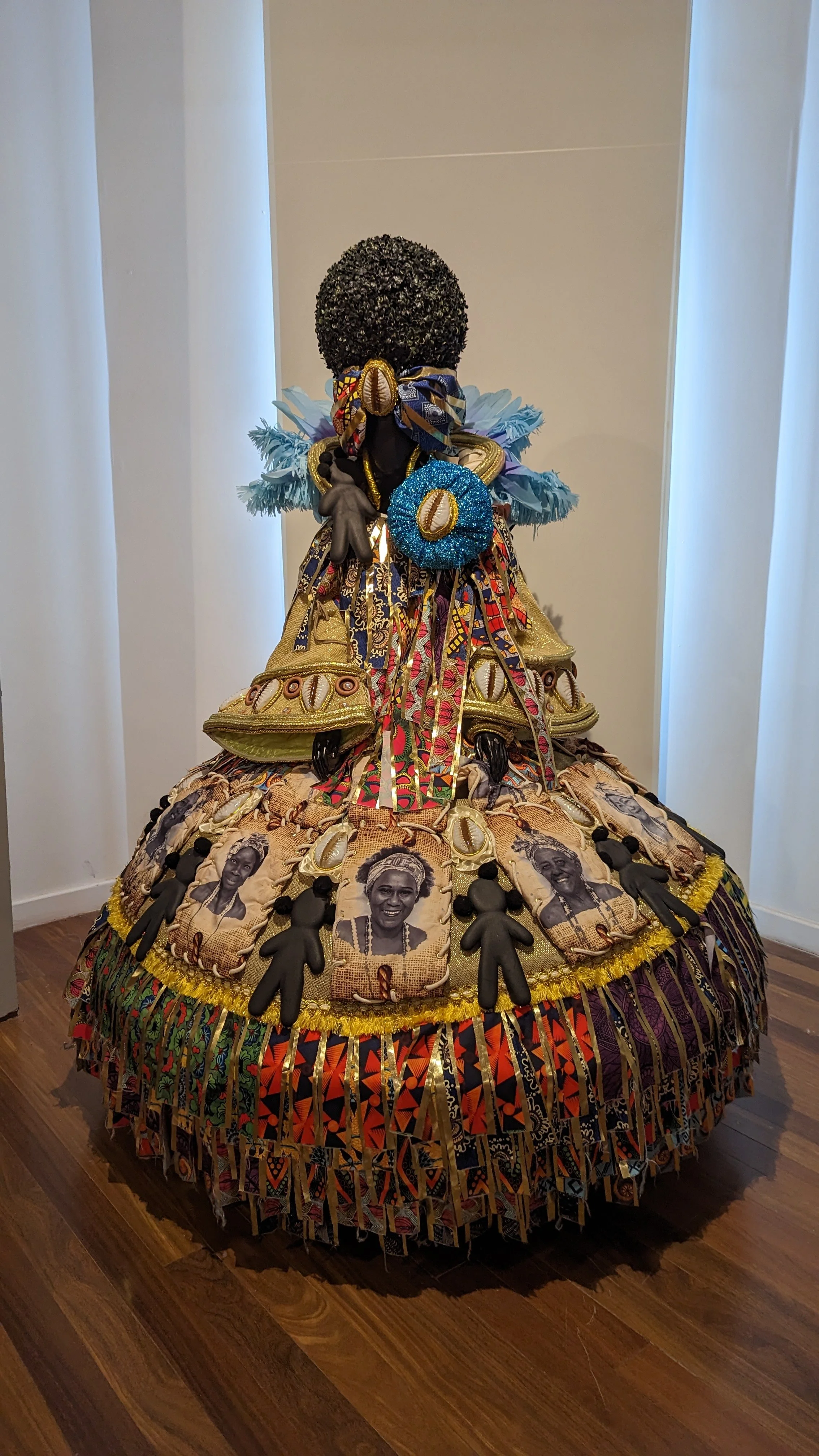
Why the West is Sleepwalking While the South Sprints
In Part 3, we talked about the Drift — the state of living inside a system that does your thinking for you, and the exhaustion of staying "in your place." Today I want to show you where the opposite of the Drift is happening, at a societal scale, in places the Western media has spent decades teaching you to overlook.
I have been tracking emerging economies for years — not as an academic exercise, but as someone actively shopping for the best infrastructure to house my life and my business. I am not watching this from a screen. I am moving through the world with my eyes open, comparing what I see on the ground with what the data actually says, and making decisions accordingly.
What I'm seeing in 2026 is a shift that most people in the West are missing entirely — not because the information isn't available, but because the story they've been told about these places makes it hard to see them clearly.
The Museum Mindset vs. The Builder's Mindset
Living in Athens gave me a sharp education in what I'll call the Museum Mindset. Parts of Europe are genuinely beautiful. But beauty built entirely on the past, without hunger for the future, eventually becomes a maintenance problem. Greece and Italy — the two European countries I've spent significant time in — are documented examples of economies suffering the consequences of nativism and demographic stagnation. They are so committed to a particular idea of who belongs that they are willing to let their economies contract and their populations age rather than evolve.
That is a choice. And it is producing predictable results.
When I look toward the Global South — specifically the emerging economies of Africa and the Middle Corridor — I see something completely different. I see the Builder's Mindset. I see hunger, problem-solving, and a relationship with the future that doesn't require permission from the past.
The Leapfrog
The Western framework teaches us that developing nations are "behind." The data in 2026 tells a different story.
While global average GDP growth sits at 3.1%, Sub-Saharan Africa is projected to grow at 4.4%. Eleven of the world's fifteen fastest-growing economies are currently on the African continent. These are not rounding errors. These are structural shifts.
What makes this particularly significant is how it's happening:
Rwanda is not waiting to be discovered. With GDP growth at 7.5%, the country has deliberately built its service sector — banking, technology, tourism — into nearly half of its entire economy. This didn't happen by accident. It happened because of decisions made at a systems level about what kind of country Rwanda intended to become.
Nigeria is running a different play entirely. The 3MTT program — a deliberate initiative to train three million tech workers — is turning the country's population density from a perceived liability into a global asset. While the US and Europe are managing crumbling infrastructure and workforce shortages, Nigeria is building the talent pipeline for the next decade.
The Middle Corridor — Kazakhstan and the broader Trans-Caspian region — is turning geography into leverage. The rail and maritime infrastructure being built there isn't a reaction to Western trade routes. It's a bypass of them.
The pattern across all of these is the same: these nations didn't wait for the West to certify them as ready. They identified what they had, built around what they lacked, and moved. They skipped landlines for mobile infrastructure. They skipped traditional banking for fintech. They are not catching up — they are building something the old system doesn't have a template for.
Why You Haven't Heard About It
The short answer is that the story you've been told about Africa and the Global South was never really about those places. It was about maintaining a particular self-image in the West.
Pity and fear are effective tools for keeping people from looking too closely at somewhere. If you pity a place you don't invest in it. If you fear it you don't visit it. If you do neither you don't notice when it starts outpacing the places you were told to admire.
I've been tracking the BRICS expansion for years. What I'm watching in 2026 is not a surprise to me — it's the physical confirmation of a direction I saw coming. While Western media cycles through its own internal crises, the Global South is building what comes next.
As an entrepreneur who has operated remotely for over fifteen years, I am not sentimental about geography. I go where the infrastructure supports the life I'm building. Increasingly, that calculus is pointing away from the places that used to be automatic answers and toward the places asking better questions about their own futures.
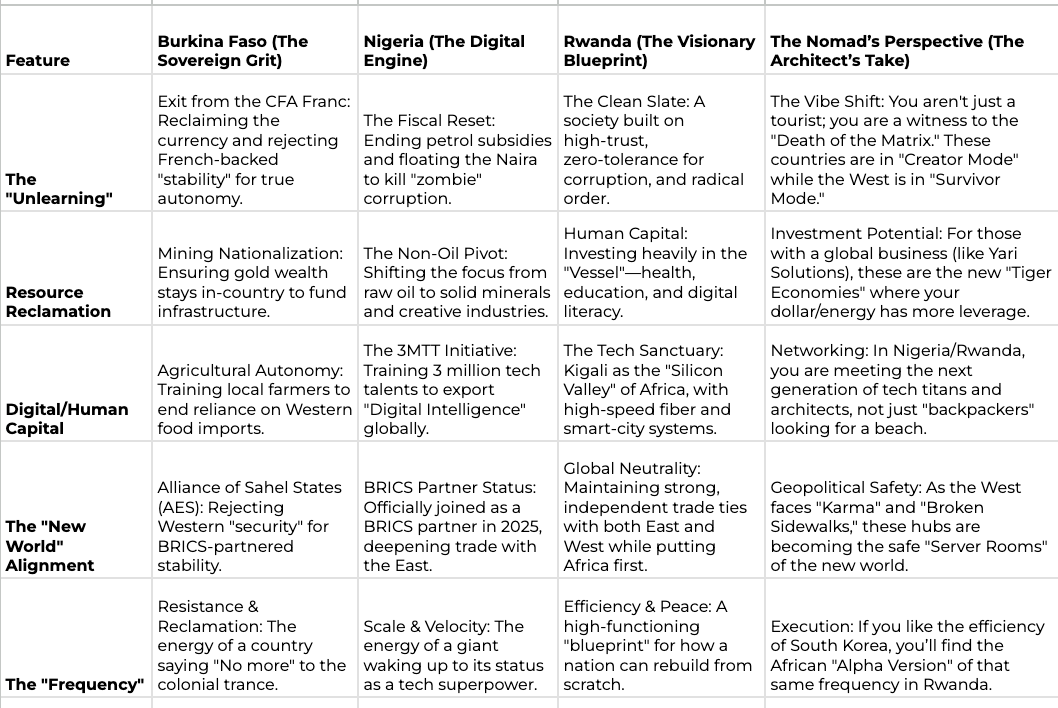
This visual represents the "Africa’s Future is Now" initiative, highlighting strategic innovation hubs like Nigeria’s digital engine, Rwanda’s visionary blueprint, and Burkina Faso’s sovereign grit. The scene emphasizes collaborative AI technology, sustainable urban development, and economic sovereignty in Africa, designed to inspire the next generation of global architects and digital nomads.
The Chaos of Birth
I want to be honest about something: the Frontier is not without difficulty. There is real instability in parts of the African continent. There are governance challenges, infrastructure gaps, and risks that anyone moving toward these places needs to assess honestly rather than romantically.
But there is a difference between the chaos of decay and the chaos of construction. What I see in the economies I've been studying is the latter — the loud, messy, high-energy disruption of something being built rather than something falling apart. Those two kinds of chaos feel completely different on the ground, and confusing them is a mistake that costs people real opportunities.
Where Are You Placing Your Bet?
If you are designing your exit — from a job, a city, a country, a system — you have to ask yourself a serious question: do you want to be somewhere that is resting on what it used to be, or somewhere that is building what it intends to become?
I am placing my resources, my attention, and my presence with the builders. Not out of sentiment but out of strategy. The places that are hungry, that are solving problems, that are treating the future as a construction project rather than a inheritance — those are the places where a person with skills, systems, and the willingness to move can do the most with what they have.
The West is not irrelevant. But it is no longer the only answer. And for those of us who were never fully centered in its version of the story anyway, that is not a loss. It is an opening.
What's Next
In Part 5, I'm going East. We're going to talk about the specific infrastructure — personal, financial, and geographical — required to make a move like this real rather than theoretical. The Quantum Leap isn't a feeling. It's a plan.
STAY IN THE LOOP:
🟢 Current Post:Awakened Architect Part 4: The African Frontier
🔵 Next Up:Awakened Architect Part 5: The Quantum Leap East
For the Mindset & Finances:Gather knowledge with our digital products in the store or expand with a course..
For the Money: Build a business that can operate on the Frontier-Sophisticated Business Strategies or get support to architect your world.
📩 Stay Notified
The "algorithm" is part of the old Piscean control system. To make sure you don't miss a "download," sign up below to get these posts delivered directly to your inbox.